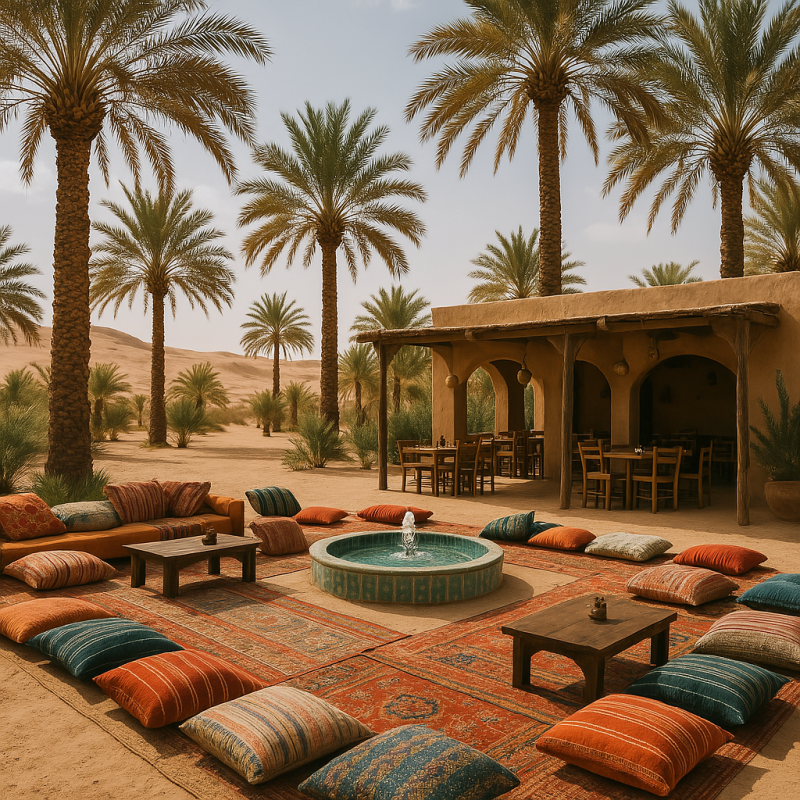
The Holistic Oasis project is an initiative aimed at transforming desert landscapes into lush, sustainable ecosystems
through regenerative agriculture practices. Here is a recap of the key components of the project:
1. Education and training: The project will provide opportunities for participants to learn about sustainable agriculture, permaculture, and environmental stewardship.
2. Planting and permaculture projects: These initiatives will focus on creating food forests, planting billions of date palm trees, and utilizing regenerative practices to revitalize desert regions.
3. Water retrieval systems: Holistic Oasis will implement innovative solutions for water management and irrigation, ensuring efficient use of this precious resource.
4. Employment opportunities: The project will prioritize inclusivity by creating job opportunities for those facing barriers to employment, such as single mothers, in various aspects of the initiative, including farming and hospitality.
5.Palm Oasis Cafées and centers fused with the Date fruit projectwill establish raw, vegan, and sugar-free dining options, promoting health and sustainability while showcasing the locally-grown produce and dates
Palm Oasis will introduce raw, vegan, and sugar-free dining options, focusing on health, sustainability, and locally sourced ingredients. Our culinary offerings will highlight the versatility of dates and regional produce, ensuring a farm-to-table experience.
Key dishes include:
- Date Seed Coffee: Coffee made from the date seeds, providing a unique and sustainable alternative to traditional coffee.
- Vegan and Rawfood Pastries: Indulge in guilt-free, delicious pastries like brownies, cheesecakes, and energy truffles made with dates, fruits, and nuts.
- Milkshakes and Nice Creams: Enjoy a selection of creamy, plant-based milkshakes and nice creams, all made without refined sugars or artificial additives.
- Smoothies: Rejuvenate with refreshing fruit smoothies packed with essential vitamins, minerals, and antioxidants.
- Chocolates: Delight in exquisite, handcrafted vegan chocolates featuring dates and other natural sweeteners.
- Date platters and date gift packages. There are many date varieties and to combine different types of dates on a platter or package is a way to cherish this nutritious beautiful fruit
This holistic approach supports local agriculture, contributes to a circular economy, and introduces innovative, health-focused dining experiences that cater to a variety of tastes and dietary needs..
6. Date fruit project .
This project showcases the versatility of the date fruit,
- Utilizing it in vegan and raw food cuisines for delicious smoothies, snacks, desserts, and even as a coffee substitute..
- Date seeds are transformed into healthy oils and used to grow new trees, while also being roasted to create a unique date seed coffee.The Date Fruit
- Date seed coffee
- Date trees for adoption
- Date trees for office
- Date trees growing courses
Project represents a comprehensive solution that combines environmental conservation, sustainable resource usage, and the promotion of healthy eating habits.
7. Social and economic empowerment: The project aims to build thriving, self-sufficient communities that benefit from a holistic approach to development, addressing social, economic, and environmental challenges simultaneously.
8. Scaling up and global impact: As the initiative grows and generates profits, Holistic Oasis plans to expand its efforts to other desert regions, creating a ripple effect of positive change and contributing to global food security.
9. Innovation in water management: The Palm Oasis project will incorporate advanced water retrieval systems, inspired by initiatives like the Warka Water Tower* project, to harness atmospheric moisture and provide a reliable water source for the food forests and date palm plantations. This will ensure that the regenerative agriculture efforts are sustainable and resilient, even in the harsh desert climate.
10. Spreading information of existing desert greening projects

Inspiration sources
By drawing upon the successes and lessons learned from inspiring individuals and organizations, Holistic Oasis seeks to create a ripple effect of positive change, demonstrating the potential for sustainable development in some of the world's most challenging environments.
The Holistic Oasis project draws upon the spirit of people's work below, aiming to create a similar transformation in desert regions around the world through regenerative agriculture and community empowerment. By combining knowledge, the team behind Holistic Oasis will inspire and environments and act in essential constructive manner.
Desert regeneration in Abu Dhabi
-
Reclamation Projects:Sheikh Zayed initiated vast projects to turn arid desert land into productive areas, leading to a significant increase in the UAE's forested area.
-
Planting Initiatives:Over 100 million trees were planted, including hardy desert species, with a focus on transforming large areas of desert by levelling dunes, applying clay to the land, and encircling areas with protective vegetation.
-
Dams and Desalination:He directed the construction of dams and seawater desalination plants to provide necessary water for his greening efforts.
Nature-Based Solutions & Biodiversity
Bamboo Ecosystems: Companies like Yaelu are exploring the use of bamboo to absorb CO₂, improve water filtration, and regenerate the soil, addressing desertification, water scarcity, and biodiversity loss.
Grazing Management: The Environment Agency – Abu Dhabi (EAD) regulates grazing through a licensing policy to protect rangelands, promote vegetation recovery, and support biodiversity.
Protected Areas: Initiatives are in place to establish and protect natural areas like Al Wathba Wetland Reserve and Mangrove National Park to preserve and expand green spaces and wildlife.
Technological Approaches
Liquid Natural Clay (LNC): Desert Control uses this nanoclay to improve the water-holding capacity of desert soils, preventing water loss and boosting soil fertility for agriculture.
Regenerative Farming Systems: Integrated Desert Farming Systems (IDFS) combine afforestation, desert greening, and regenerative soil management, using treated wastewater and organic amendments to transform degraded lands into productive ecosystems.
Biochar and Microalgae: Firms like Hyvegeo are developing soil amendments from biochar and microalgae, infused with nutrients and microbes, to improve soil quality and increase carbon sequestration.
Strategic Initiatives
Artificial Forests & Green Belts: The UAE has actively worked to reclaim desert lands by establishing artificial forests and green belts using native and salt-tolerant plants to curb desertification.
Cloud Seeding: The UAE invests in cloud seeding to increase rainfall and enhance natural precipitation, a crucial element for desert greening efforts in this water-scarce region.
Sustainable Agriculture: Technologies are being developed for large-scale desert agriculture, with initiatives focusing on growing crops suited to the arid climate, like wheat, using advanced irrigation and soil management techniques.
Strong Leadership examples
Desert regeneration in Abu Dhabi was largely pioneered by the UAE's long-time leader,
Sheikh Zayed bin Sultan Al Nahyan
who invested heavily in ambitious reclamation projects to transform the desert into a fertile landscape by reclaiming land, planting millions of trees, and implementing advanced agricultural techniques like water-efficient systems and soil enrichment with biochar. His environmental vision continues through government initiatives focusing on sustainable agriculture, food security, and combating desertification through innovation and public engagement.
Early Efforts and Vision
Reclamation Projects: Sheikh Zayed initiated vast projects to turn arid desert land into productive areas, leading to a significant increase in the UAE's forested area.
Planting Initiatives: Over 100 million trees were planted, including hardy desert species, with a focus on transforming large areas of desert by levelling dunes, applying clay to the land, and encircling areas with protective vegetation.
Dams and Desalination: He directed the construction of dams and seawater desalination plants to provide necessary water for his greening efforts.
Technological and Scientific Approaches
Research and Innovation: Sheikh Zayed supported research and innovation in agriculture and environmental work, collaborating with global institutions like the University of Arizona.
Soil Enhancement: Techniques such as the use of biochar, created from organic waste, were encouraged to enrich the soil, improving water retention and nutrient availability.
Water Conservation: Efforts were made to educate farmers on minimizing water use and implementing efficient irrigation systems, aided by AI and thermal imaging in some projects.
Modern Continuity and Legacy
Government Initiatives: Today's leadership continues Sheikh Zayed's passion for agriculture, with plans to significantly boost agricultural output by 2051.
Combating Desertification: The UAE focuses on scientific research, promoting biodiversity, protecting native plants, and using efficient water management to combat desertification.
Public and Private Partnerships: The government and private sector collaborate on initiatives like the use of microalgae and biochar to regenerate soil, turning organic waste into valuable compost.
Jadav Payeng, the "Forest Man of India,
" who single-handedly planted a lush forest on a barren sandbar in Assam, India. Over the course of several decades, Payeng transformed a desolate landscape into a thriving ecosystem, home to a diverse array of plant and animal life.
The Greening the Desert Project by Nadia & Geoff Lawton,
is living proof that we can reverse desertification and bring back life to desolate barren lands. By living in harmony with nature and applying permaculture design practices to the landscape the possibilities are endless

Princess Basma's work
is an inspiration for the holistic oasis desert recovery project. Her dedication to sustainable design and environmental preservation is certainly commendable..

It makes 100 liters of water a day. It’s called Warka Water in the Desert
and it’s a kind of tree that takes away the thirst. It produces water in arid regions, a region of the world where drought is widespread and where the serious food crisis hit in 2016, according to ONU report
During a trip to arid landscapes, the Arturo Vittori , whose studies focused on energy optimization, aimed at allowing human life in contexts devoid of any resource and, first of all, water, immune to the plague of indifference, was deeply shocked to see women and children walking for miles under the suffocating heat, with the sole aim of procuring drinking water, transported with heavy jerrycans to the villages, in a sort of pagan ritual for survival, which is constantly repeated, day after day, for a lifetime.
The Architect Arturo Vittori, with his collaborator, Andreas Vogler
Studio of the Architecture and Vision studio, CEO of the non-profit Warka Water Inc Inc. and founder of the fashion brand Culture à Porte, with the support of the Italian Center of Culture of Addis Ababa and the EiABC (Ethiopian Institute of Architecture, Building Construction and City Development)
decided to put an end to this problem
A great architect, like the inventors of ancient civilizations, develops the ability to solve problems thanks to the spirit of observation of the surrounding nature, which very often guards the answers to puzzles that seem to the most insuperable, able to be caught only by the most attentive and receptive. developed with Kickstarter and realized directly on the Ethiopian territory thanks to the support of the Italian Cooperation. Then it was a race for improvement.
Warka water tower
Recognizing the gravity of the situation, the Warka Water Tower project set out to design an innovative, sustainable, and community-centric solution. The project was founded in 2012 by Italian architect and artist Arturo Vittori.
Arturo Vittori is known for his innovative and sustainable designs, and the Warka Water project represents one of his notable initiatives to address water scarcity and improve water accessibility in remote and challenging areas.
The term 'Warka' comes from the Warka Tree, a native and wild large fig tree found in Ethiopia. This tree holds significant symbolic importance as it plays an important role in the local ecosystem, and also serves as a gathering place. It also holds a spiritual significance, representing a place for prayer to God.
Warka Water Towers are innovative structures designed to harvest potable water from the atmosphere. The towers are inspired by nature's water collection methods, particularly the way certain plants capture dew and moisture. The outer framework of the towers resembles large, woven baskets and is constructed using locally sourced and biodegradable materials like bamboo to ensure minimal environmental impact.
How. The primary function of Warka Water Towers is to capture dew and moisture from the air as it passes through a mesh-like structure.
The collected water then drips down to a storage chamber at the base of the tower, where it undergoes purification to make it suitable for drinking. The towers provide an off-grid and low-cost alternative to conventional water infrastructure, making them particularly relevant in regions where establishing traditional water supply systems is challenging.
The first Warka Tower pilot was constructed in 2015 in Dorze, a rural community in south Ethiopia. After this successful initiative, the “Warka Water Inc.”, a non-profit organisation, based in the USA was founded as a platform for other social actions.
Subsequently, the initiative expanded its reach with the construction of a second pilot project in Cameroon, specifically in the South Region, in 2019. The project selects locations with high levels of fog or humidity as these conditions are most suitable for the optimal functionality of Warka Towers.
The towers are designed to provide 40 to 80 litres of drinking water daily for the community, depending on weather conditions. They are built using local, natural and biodegradable materials like bamboo, wood, raffia palm leaves, dry straw, dry reeds etc and simple tools are used in the building of the towers so that they can be easily maintained by the local villagers without the need of scaffolding or electrical tools. The tower not only addresses the fundamental need for water but also serves as a communal space, where people can gather for education and public meetings under the shade of its canopy.
An interesting part of the project is that it involves and empowers the local population. The initiative does not merely provide a solution but ensures that the local villagers can own and operate the towers, a key factor in the project's success. Each version of the Warka Tower shares the same design philosophy but differs in shape, geometry, and materials adopted, making it a versatile and adaptable solution.
The Warka Water project is like a bright light of innovation challenging traditional water supply systems. Warka Towers show how we can design things to last and make communities stronger.
They're not just practical; they also promise a healthier future for communities facing water scarcity. From 2012 until now, the project has not just grown; it's become a symbol of hope, sustainability, and a shared commitment to ensure that everyone has access to clean water and is designed to harvest water from the atmosphere (rain, fog, dew) providing an alternative water source for rural populations that face challenges accessing drinkable water.
It is a passivewater source designed by to serve rural populations located in isolated regions where conventional pipelines and infrastructures will never reach and where water is not available from wells. WW should not be considered the solution to all water problems in developing countries but rather a tool that works well at providing clean water in specific areas. Those remote communities, often with limited financial means, struggle to find reliable supplies of clean water.
WW not only provides a fundamental resource for life, water, but it incorporate another important function, it is social place for the community where to organize reunions protected under the shade of its canopy. Workshop and educational activities for children will be organized to educate them about the importance of clean safe water and more in general about the renewable resources for a sustainable future.
The project name comes from the Warka tree that is an institution for the Ethiopian culture. Its shade is used for traditional public gatherings, and children reunite for the acquisition of knowledge. We are focused on creating a beautiful yet useful structure that can blend into the natural and cultural environment of the rural communities.
-
https://warkawater.org/documentary/
-
Contact Ushttps://warkawater.org/
-
https://voisl.indevconsultancy.in/article/warka-towers-a-promise-of-better-cleaner-water-for-all
-
World Design Organization. e: office@wdo.org
19 Trees and shrubs than can contribute to reforestation
There are several tree species known for their drought-resistant properties and potential to thrive in desert-like conditions, including:
1. Neem Tree (Azadirachta indica): Known for its fast growth, resilience, and numerous medicinal properties.
2. Mesquite Tree (Prosopis spp.): A hardy tree that produces edible seed pods and provides shade.
3. Ironwood Tree (Olneya tesota): A slow-growing but long-lived tree that can survive extreme heat and drought.
4. Acacia Tree (Acacia spp.): Various species of Acacia are suitable for desert environments, providing food and habitat for wildlife.
5. Palo Verde Tree (Parkinsonia spp.): Features a distinctive green bark and produces beautiful yellow flowers.
6. Desert Willow (Chilopsis linearis): A flowering tree that attracts hummingbirds and other pollinators.
7. Jojoba (Simmondsia chinensis): A drought-tolerant shrub with edible seeds and various uses in cosmetics and lubricants.
8. Date Palm (Phoenix dactylifera): Known for producing sweet fruits and providing shade in hot climates.
9. Tamarisk (Tamarix spp.): A small tree with scale-like leaves that can tolerate high salt levels in the soil.
10. Moringa Tree (Moringa oleifera): Known as the "miracle tree" for its high nutrient content and versatile uses in food, medicine, and water purification.
11. Baobab tree (Adansonia spp.) is another remarkable tree species known for its ability to thrive in arid environments, making it an excellent choice for reforestation efforts in desert-like conditions. Native to Africa and Australia, the Baobab tree is known for its unique, distinctive appearance, with a thick, bottle-shaped trunk that can store large amounts of water during dry periods. In addition to its drought-resistant properties, the Baobab tree offers numerous benefits, including: *
*Nutrient-rich fruits: The tree produces large, edible fruits known as "monkey bread" or "cream of tartar fruit," which are rich in vitamin C, antioxidants, and other essential nutrients.
Medicinal uses: Various parts of the tree, such as the leaves, bark, and fruit, have been used in traditional medicine to treat ailments ranging from digestive issues to skin conditions.
Environmental benefits: Baobab trees provide habitat for wildlife, contribute to soil fertility, and help prevent soil erosion.
Economic opportunities: Local communities can benefit from the commercialization of Baobab products, such as fruit pulp, seeds, and oil, providing income and promoting sustainable livelihoods.
Incorporating the Baobab tree into reforestation efforts can help restore and maintain the ecological balance in arid regions while offering valuable resources to local populations.
12. Mulga (Acacia aneura): A fast-growing, nitrogen-fixing shrub that provides food and shelter for wildlife.
13. Cactus Pear (Opuntia spp.): A drought-tolerant cactus with edible fruits and pads.
14. Joshua Tree (Yucca brevifolia): A symbol of the Mojave Desert, this tree supports a variety of wildlife and provides habitat for several endangered species.
15. Desert Almond (Prunus fasciculata): A shrub with fragrant flowers and edible nuts, often used as a windbreak and for erosion control.
16. Buffalo Gourdv(Cucurbita foetidissima): A sprawling vine with edible seeds, which also provides ground cover and prevents soil erosion.
17. Ephedra (Ephedra spp.): A drought-tolerant shrub with various medicinal uses, contributing to soil stabilization and erosion control.
18. Holi Tulsi also known as holy basil or Ocimum tenuiflorum, is a sacred plant in Hinduism and is widely used in Ayurvedic medicine for its potential health benefits, including stress relief and anti-inflammatory properties. It is often consumed as tea or used in various culinary dishes.also known as Tulsi, can tolerate short dry periods once established, but it prefers regular watering to maintain healthy foliage and flavor. It is not fully drought-resistant and requires consistent moisture for optimal growth.
The trees and shrubs above can contribute to reforestation efforts in arid regions and provide valuable resources to local communities. It's essential to select species that are well-suited to the specific climate and soil conditions of the area in question to ensure their successful establishment and growth
- *Baobab: Nutrient-rich fruits: The tree produces large, edible fruits known as "monkey bread" or "cream of tartar fruit," which are rich in vitamin C, antioxidants, and other essential nutrients.
- Medicinal uses: Various parts of the tree, such as the leaves, bark, and fruit, have been used in traditional medicine to treat ailments ranging from digestive issues to skin conditions.
- Environmental benefits: Baobab trees provide habitat for wildlife, contribute to soil fertility, and help prevent soil erosion.
- Economic opportunities: Local communities can benefit from the commercialization of Baobab products, such as fruit pulp, seeds, and oil, providing income and promoting sustainable livelihoods.
Incorporating the Baobab tree into reforestation efforts can help restore and maintain the ecological balance in arid regions while offering valuable resources to local populations.
Extra's
While the plants below may not be the most drought-resistant options, their adaptability to a range of environments and their valuable medicinal properties make them potential candidates for desert regeneration projects
18. Amla (Phyllanthus emblica), also known as Indian Gooseberry. Adaptation: While not specifically desert-adapted, Amla is known to grow in a wide range of conditions, including dry and nutrient-poor soils. Benefits: Amla is rich in vitamin C, antioxidants, and other nutrients, making it a valuable food source and medicinal plant.
19. Haritaki: Adaptation: Haritaki is a hardy tree that can tolerate various environmental conditions, including dry and rocky soils. Benefits: Haritaki has been used in traditional Ayurvedic medicine for its numerous health benefits, including digestive, anti-inflammatory, and immune-boosting properties.

Revitalizing Desert Land into an Exclusive Office Oasis
The Palm Revival Experience offers companies the unique opportunity to transform barren desert land into a thriving office oasis, complete with lush palm trees, various plants, and authentic Bedouin tents. This exclusive experience provides the following benefits:
1. Enhanced Work Environment:
Create a serene and rejuvenating atmosphere for employees to enjoy during breaks or outdoor meetings, fostering a healthier work-life balance.
2. VIP Client Engagement:
Host important clients in this enchanting setting, providing a memorable and distinctive experience that showcases your commitment to sustainability and cultural appreciation.
3. Team Building Opportunities:
Offer employees a chance to participate in the transformation process, nurturing teamwork, camaraderie, and a sense of shared accomplishment.
4. Sustainability Commitment:
Showcase your dedication to environmental stewardship by revitalizing desert land and promoting biodiversity, further enhancing your company's reputation and public perception.
The Palm Revival VIP Experience provides an unparalleled opportunity to create an exclusive office oasis that benefits your employees, clients, and the environment alike
Below more possible use and benefits of this company project
Here's a list of benefits highlighting the value of implementing the Holistic Oasis initiative:
1. Enhanced Employee Well-being:
Prioritizing self-care and personal comfort can improve employee mental and physical health, leading to increased productivity and job satisfaction.
2. Stronger Team Cohesion:
Collaborative activities, workshops, and events can foster a sense of camaraderie among employees, improving teamwork and overall performance.
3. Improved Work-Life Balance:
By creating a welcoming environment for families and encouraging relaxation, the initiative can help employees achieve a healthier balance between their professional and personal lives.
4. Environmental Stewardship:
The focus on sustainability, biodiversity, and organic gardening can contribute positively to the environment and help raise awareness about the importance of ecological preservation.
5. Local Community Engagement:
Involving the local community in events and workshops can strengthen relationships between the company and its neighbors, promoting goodwill and positive public perception.
6. Educational Opportunities:
Providing educational experiences for employees, their families, and the community can promote lifelong learning and personal growth, as well as raise awareness about important issues such as sustainability and self-care.
7. Enhanced Company Image:
Following a commitment to employee well-being, sustainability, and community engagement can improve the company's public image and attract like-minded customers, partners, and employees.
By presenting these benefits, the CEO can gain a comprehensive understanding of the Holistic Oasis initiative's potential to create positive change for the company, its employees, and the wider community.
8. Remote Working Space:
Providing a serene, natural setting for employees to work remotely can boost morale, creativity, and overall job satisfaction. Offering Wi-Fi access and comfortable seating areas can make the garden an ideal spot for focused work or collaboration.
9. Family-Friendly Activities:
Inviting employees' families to join in on weekends can create a welcoming and inclusive environment. By offering family-oriented activities, such as gardening workshops, cooking demonstrations, or arts and crafts sessions using materials from the garden, the initiative can foster a sense of community and connection.
10. Educational Opportunities:
- Educational Opportunities: The garden can serve as an educational space for employees and guests to learn about sustainable gardening practices, fostering a greater appreciation for nature and the environment
- Engaging children in hands-on activities that promote environmental stewardship can help them develop an appreciation for nature and sustainability from a young age. These experiences can have a lasting impact and may inspire future generations to prioritize the well-being of the planet.
11. Relaxation and Networking:
Offering a space for families to connect with each other and with nature can create lasting memories and encourage a healthy work-life balance. Providing shaded seating areas, picnic spots, or a playground can make the garden an inviting retreat for families to enjoy.
12. Impact that matters
Collaborating with experts (like Geoff Lawton https://www.greeningthedesertproject.org/ )
can help transform the adopted land into a thriving, sustainable garden that not only cultivates dates but also supports the growth of various beneficial plants. This holistic approach to gardening can provide several advantages
- Enhanced Biodiversity: Incorporating a variety of plants and trees can contribute to increased biodiversity, promoting a healthier ecosystem and attracting local wildlife.
13. Grown Produce:
Growing a diverse selection of fruits, vegetables, and herbs on-site allows the office to utilize fresh, organic produce in their cafe or for employees to enjoy.
Shade-Loving Plants: Make the most of the shaded areas beneath the date palms by planting shade-tolerant species, such as ferns, hostas, or various edible plants like mint, lettuce, and spinach.
14. Stress-Relieving Environment:
A lush, green garden can provide a calming, stress-relieving environment for employees to retreat to during breaks or for outdoor meetings and collaboration sessions.
Here are a few more suggestions to further enhance the appeal and benefits of the Date Project and Bedouin-style tent within the Holistic Oasis initiative:
Culinary activities:
Showcasing how dates can be used in various dishes and treats. This can inspire employees and guests to incorporate dates into their own cooking and appreciate their versatility.
Date Tasting Sessions:
Organize date tasting events, allowing participants to sample different varieties of dates and learn about their unique flavors, textures, and origins.
Community Involvement:
Encourage local community members to participate in the Date Project, fostering a sense of camaraderie and shared responsibility for environmental stewardship.
Local Artist Collaborations:
Partner with local artists or artisans to create unique, date-inspired art pieces or functional items, such as pottery, textiles, or jewelry. These creations can be displayed in the Bedouin-style tent or sold as souvenirs, supporting local artists and providing a tangible connection to the initiative.
Date-Themed Workshops:
Host workshops focused on topics related to dates, such as their history, cultivation, and health benefits. This can provide additional educational opportunities for employees and guests, further enriching their experience.
Date-Infused Corporate Gifts:
Create customized corporate gifts using dates or date-inspired items, such as date-filled chocolates, date jams, or date syrup. These gifts can be given to important guests or clients as a unique and meaningful token of appreciation.
By incorporating these suggestions, companies can continue to enhance the appeal and impact of the Holistic Oasis initiative, creating memorable experiences and promoting a deeper understanding of the cultural, environmental, and culinary significance of dates within the UAE.
By creating a diverse and sustainable garden, the Holistic Oasis initiative can further contribute to the well-being of employees and the environment, offering numerous benefits and opportunities for growth and connection.